Tag: house cleaning services

  • What to Expect with Regular Home Cleaning Services

    What to Expect with Regular Home Cleaning Services

    This is the year you finally decided to spend more quality time with your family; time that doesn’t involve a mop, broom, or scrub brush. That’s right – this is the year you are taking back this valuable time by hiring a home cleaning service. Someone else can clean so you don’t have to.

    Now, the only thing that’s left is to understand how often you want your cleaners to come in and what will be cleaned when they’re there. That’s what we’re here to help with today, providing clarity on what to expect when you work with a professional cleaning company. Let’s dive in!

    When you receive regular cleaning services, you typically invest in weekly or biweekly cleaning. If you’re looking for a monthly clean, this is considered a deep clean as it often takes more time to complete. One reason is that with weekly/biweekly cleaning, we’re able to rotate what is cleaned each time, whereby a monthly cleaning requires everything to be cleaned in one fell swoop.

    Once we determine which service it is you’re looking for, we schedule our initial cleaning visit. This visit is typically a deep clean as the first clean almost always takes a bit longer for a few reasons:

    1. We’re getting used to the overall layout of the house.

    2. We’re creating a clean slate so we’re all on the same page as to what “clean” is. Every so often, we walk into a home to learn that the house isn’t quite ready for a simple regular clean.

    3. We set up our working relationship, learning your expectations and how we can best meet them.

    After the initial deep clean visit, we begin our weekly/biweekly regular services. What follows is a breakdown of what your investment includes.


    Bathrooms

    As one of the least clean spaces in your home (sorry – it’s true), we always clean the bathroom. This includes scrubbing the toilets, sinks, showers and tubs, along with a wipe down of the baseboards, walls and cabinets.

    If weekly, we do a full cleaning of the outsides of the walls and cabinets every second time we are in there (e.g., weeks 1 and 3). For biweekly, this is done each time.


    Kitchen

    A standard kitchen cleaning involves washing counters and stove tops, and wiping down the outside of the oven, dishwasher, and fridge, along with the inside and outside of the microwave. On the counters, we make sure to lift and clean underneath items (e.g., coffee machine, knife blocks, etc.). Note that the less there is on the counter for us to clean around, the more time we’re able to save, which allows you to save money because we do not have to work around as many objects.

    What is not included is doing the dishes – unless specifically requested. If the sink is full of dishes, we are unable to do the work you hired us for. We will most likely put them in the dishwasher but note that this will be added as an additional service.

    Every fourth week (or every second time for biweekly cleans), we do a complete wipe down of the cabinets.

    If you require us to clean inside things, such as the inside of the fridge, oven, cabinets, or drawers, this does add extra time. Depending on what this special request is will determine how this influences your budget. These extra request cleanings are completed only at your discretion and request.


    Dusting

    This is where we often have a miscommunication in expectations with clients. While we do a basic dusting each time we’re there, we do not dust everything. This includes high-cleaning items (items above the cabinets, tops of shelves, etc.), door frames, baseboards, and so forth. These are dusted on a rotating schedule, typically done every fourth week for weekly cleaning, and every second time for biweekly. 


    Floors

    Your floors deserve TLC every single time we’re there. This is why we always do a thorough vacuum and mop (in the rooms you ask us to). A few things to note about this:

    1. If we’re able to easily reach our vacuums/mops under your furniture, then we’ll be able to clean underneath them.

    2. If you would like us to clean underneath your furniture, we ask that you move it as we typically do not move furniture, particularly on floors, to avoid scratching your flooring material. This also requires a bit extra time; therefore, we ask to schedule this in advance of the regular cleaning.

    3. We do vacuum fabric furniture (e.g., sofas). However, if it is a huge sectional, this can take 30+ minutes, especially if there is a lot of animal hair involved. If you need us to vacuum this item, we ask that you book extra time.


    Common Bits and Pieces

    There are three items that we’re often asked about: bedding, garbage, and the “little things”.

    1. Changing bedsheets – this is a special request that you must make in advance. We ask that you leave the clean sheets on the bed you’d like us to put them on. However, we do not launder them as there are often personal preferences when it comes to doing the laundry.

    2. Taking out the garbage – we collect and take this out each and every time. However, we leave the compost and recycling up to the customer as people have preferences as to how they like to sort these items.

    3. “Little things” – we do our best to clean what we can in the amount of time you’ve booked. Sometimes we’re able to squeeze in those little extras (e.g., wiping your dog’s nose art off the inside of your front window). However, all these “little things” quickly add up to a half hour or more. This is why we prefer to work on a rotating schedule when it comes to weekly/biweekly regular cleaning services. All we ask is to remember that while we are always happy to help clean your home, we are still a business, and our cleaners deserve to be paid for their time. Be clear with your expectations and we can ensure we are able to meet them within the right amount of dedicated time.

    If you still have questions as to what you should look for beyond, “what’s included in a regular clean,” please read this blog for common questions we hear when scheduling new clients. 


    One Final Note

    Cleaners do not come in to tidy up. We come to clean your home. This is easier when clothes are put away, dishes are in the dishwasher (not in the sink), and toys are tucked away instead of scattered on the floor. This way, we can do what we do best – make your home sparkle and give you more time with the people you want to spend time with.

    To inquire about our services or to book an initial quote, connect with us today.
  • Deep Cleaning or Move-out Cleaning – What’s the Difference?!

    Deep Cleaning or Move-out Cleaning – What’s the Difference?!

    You’re moving! That’s fantastic. Now what? You’ve heard that you need to have your house deeply cleaned prior to the new owners moving into your old residence. Yet, you’re not sure if you merely need a deep clean or a more in-depth move-out clean. Despite their similarities, there are key differences to consider. So, how do you know which cleaning is the one you need for your move out?

    Let’s break down the similarities and differences to better support you in moving forward.


    The Cleaning Similarities

    The easiest place to start is understanding the similarities between deep and move-out cleans.

    Typically, the same amount of time for cleaning is involved, often resulting in the same price. Remembering that this is physical labour, we often send two-three cleaning professionals to divide and conquer the dust and grime. The key is to get the cleaning done all in one day. This tends to be better for both you – the customer – and our team. The reason is that it:

    • ensures ease in scheduling and coordinating of people (including your family’s schedule)

    • reduces the days that cleaning is on your mind

    • gives you your space back so you can focus on other things…like MOVING!

    Whether a deep or move-out clean, both typically involve cleaning things that are not included in regular cleans, such as washing your doors, baseboards, and walls.


    The Cleaning Differences

    Now, for the fun part – breaking down the differences between these types of cleanings.


    Deep Cleaning

    The primary difference between a deep cleaning and a move-out cleaning is that, with a deep clean, you still live in the house. All your furniture and other possessions are still in your home.

    While the deep clean details depend on the customer’s needs, it typically involves:

    • A top to bottom, left to right thorough cleaning of (almost) everything. When thinking “deep clean,” many people liken this to Spring Cleaning. Learn more about what’s involved in this type of clean here.

    • Cleaning behind/under appliances. If these items are not on sliders or wheels, we ask the customer to pull these away from the wall so we do not inadvertently harm the floor. Note that we recommend that you clean behind your appliances at a minimum of once per year, especially if you have pets.

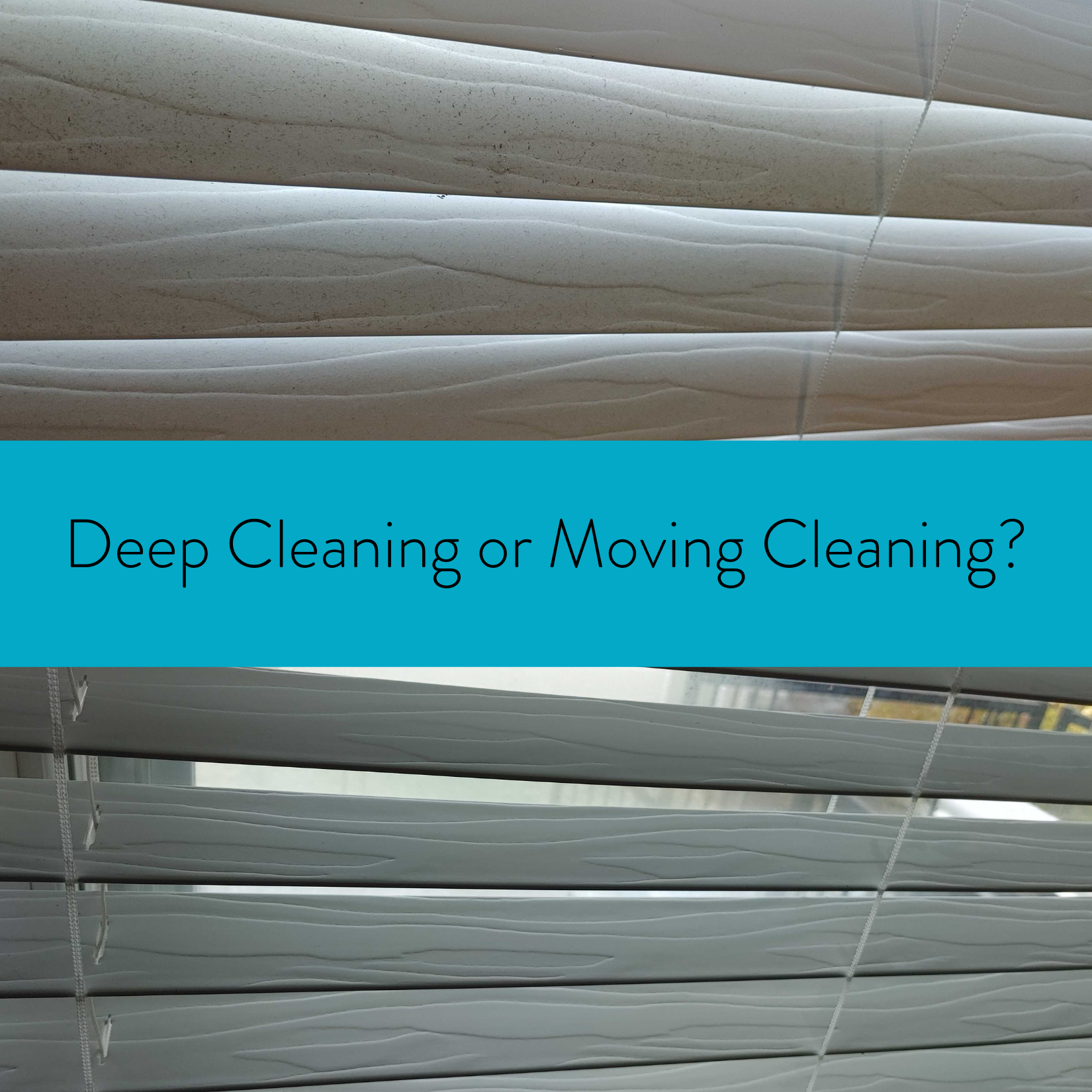
    • Detailed blind cleaning. Yep – we clean even the blinds. This is quite time consuming as we have to wash each one separately, getting in between each vane to remove the dust, dirt, and grime that’s accumulated over the year(s). This is an arduous task as the cleaner tends to have their hands above their head the majority of the time. From a time perspective, if there are 10 blinds in a house we have to clean, this takes roughly two-three hours because of the detailed nature of this cleaning.

    • Braving the bathroom. This goes beyond the regular bathroom cleaning with items such as washing the walls, vacuuming the vent, and deep cleaning the toilet beyond our regular scrubbing. However, we do not go into cabinets as this is where personal items, such as medications, are stored.

    • Closets, closets, closets. Rarely do families think about cleaning the holder of their shoes, jackets, and mittens…which is why they tend to need a deeeeeeeep cleaning at least once a year. Here, we pull everything out and get to work, washing the walls, vacuuming the dirt/stones/grime/hair and other “interesting” things that accumulate over the year. Don’t worry – we always put things back (and in an organized fashion).

    • Sofa and other seating fun. Oh, the goodies we find when we lift and clean within cushions and under the couch – money, candies, toys, and ALL the lost socks. If the couch is made of leather, we wipe it down with a cloth, removing any stains or stickiness that may be long forgotten about. If made of fabric, then we get our vacuum out and vacuum away. Here is where those fancy vacuum attachments come into play.

     The basic premise for deep cleaning is that anything we can move without damaging property, we move. Anything we can get underneath, we get under.

     There are a few specialty items that a deep clean does not include:

    • Inside of cabinets. Like the bathroom medicine cabinet, cabinets in the kitchen or laundry room typically still contain your items because you are occupying the property (e.g., dishes, pots, utensils, etc.). Therefore, we don’t clean them.

    • China cabinets and other specialty display cases. These tend to contain highly sentimental and breakable items. If a client requires us to clean the items in the cabinet, we ask them to remove them from the cabinet and put these items on the table for us to clean. The customer is responsible for putting the items back in the cabinet itself.


    Move-out cleaning

    For move-out cleans, the house is now empty. Furniture is all removed, cabinets are empty, and every single corner is cleaned. The biggest misconception surrounding a move-out clean is that because it’s empty, cleaning will go faster. This is not the case. When a house is empty, this is when all dirt and scuffs are exposed. This rarely involves a simple wipe for all to be suddenly clean. Rather, we often have to “wipe” multiple times – with extra arm grease – to remove years of untouched dirt, oil spatters, hidden bugs, and long-forgotten spills. A few items that further separate the move out clean from a deep clean include:


    • Kitchen Cleaning!

    ○      Have you ever looked at the top of your cabinets? This is where alllllll the years of grime collect, taking extra effort to remove.

    ○      Have you looked in an empty pantry? We have and it sometimes frightens even the toughest of cleaning professionals, particularly if the pantry contains wireframes. Like cleaning the blinds, this is time-consuming as it requires going in between each individual wire, wiping down and removing any spills – often sticky thanks to the bottles that once sat there (e.g., oil, dressings, vanilla, and other common baking/cooking items).

    ○      Have you ever truly looked behind your stove or fridge? You’d be surprised at what you’ll find…and how much effort it takes to remove the caked-on gunk. Washing the walls and the appliances themselves (often inside and out) is required prior to the new owners taking possession.

    • Cabinet cleaning. Unlike deep cleaning, we can now go into the empty cabinets and wash the insides, removing any food bits, soap scum, and other friendly critters (e.g., dead bugs) that may be lingering.

    • Walls walls walls. With your furniture completely out of the space, we are able to see where the furniture may have rubbed the wall, leaving a bit of dirt, fingerprints, and more. A thorough and detailed washing is what’s needed.

    • Lights and other overhead fixtures. With a move-out clean, we remove light fixtures and wash them with soap/water, often finding dead bugs and dust balls within them.


    Ultimately, a move-out clean is a deep cleaning x10! We do everything, top to bottom, corner to corner, until the house sparkles for the new owners.


    One thing that reduces a move-out cleaning time is if you require a staging clean to support your house selling efforts. Here, we do the top of the cabinets, wash the outside of the cabinets, and the inside and outside of appliances, particularly since potential buyers often look inside of these. If you invest in a staging clean, then the final move-out clean typically requires a touch-up of the baseboards and a simple dusting. This breaks the cleaning into two parts.


    To learn more about the ins and outs of the differences in our deep and our move-out cleaning, download our checklists below.


    While a deep clean and a move-out clean are similar, it’s important to know the differences between the types of cleanings so you can book and budget the proper cleaning for you.

    If you are looking at booking a cleaning for your home, connect today and book away.

    If you have further questions, visit our FAQ page for answers.


    DEEP CLEAN CHECKLIST

    MOVE-IN/OUT CLEANING CHECKLIST

  • The 3 Types of Clean: Cleaned, Sanitized and Disinfected

    The 3 Types of Clean: Cleaned, Sanitized and Disinfected

    Cleaning, sanitizing and disinfecting – since COVID, these terms have flooded our lives, newsfeeds filling with articles using these words interchangeably and scaring the bejeebus out of readers, including me at times…and I’m a cleaning business owner!

    Customers have been asking more and more exactly what the difference is and should people even care. My simple answer is yes. Absolutely, you should care. A properly cleaned home provides a healthy environment. So, for this month’s blog, I wanted to take a moment to break down what each of these terms means and how your residential cleaner uses them to provide you with a higher quality of life.


    cleaning-Woman-wiping-down-kitchen-countertop.jpg


    CLEANING WITH CLARITY

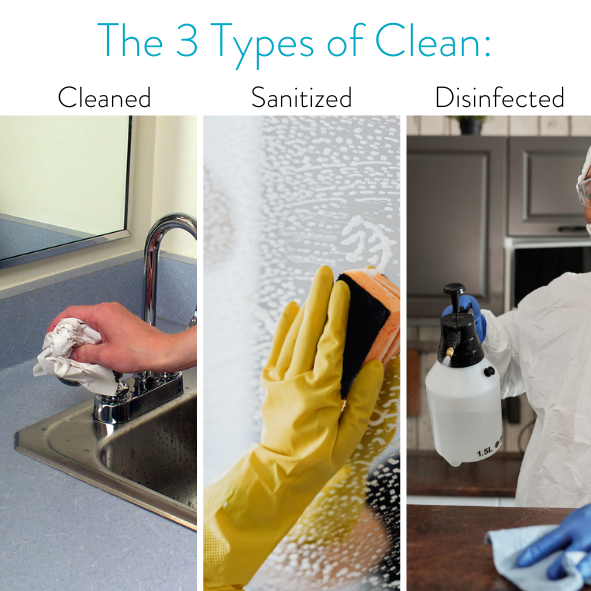
    To clean is to remove dirt, debris, dust and other unwanted materials from surfaces. It may or may not involve tidying up (e.g. organizing and putting things in their place) and can include simple cleaning agents, such as soap or detergent. Regular cleaning keeps your place looking and smelling nice while also reducing the germs living on the surface. However, cleaning on its own will not have the same benefits or peace of mind as sanitizing and disinfecting.

    To clean, think “simple wiping.”


    Sanitizing-Person-is-cleaning-granite-sink-in-kitchen-with-cloth.jpg


    SANITIZING MADE SIMPLE

    Sanitizing is a step up from cleaning. Similar to cleaning with the removal of debris, sanitizing further reduces the germs living on a surface. This act focuses on eliminating these pathogens and microorganisms that can transfer germs, such as COVID or the flu. Sanitizing typically uses a chemical agent of sorts (e.g. bleach or even steam), reducing the germs that come in contact with the agent. Specific touchpoints that require regular sanitization include handles, doorknobs, TV controllers, keyboards, kitchen utensils, and other high touch shared surfaces in your home.

    To sanitize, think “wiping with a cleaning agent.”


    Disinfecting-Woman-cleaning-bathroom-with-spray-bottle.jpg


    DISINFECTING DEFINED

    Disinfecting is the highest form of germ and debris removal. While sanitizing does an excellent job of reducing pathogens, it is typically done in a quick fashion and does not always kill them. The goal of disinfecting is to kill all microorganisms, leaving a sterile environment behind. This is particularly crucial in hospitals and special care facilities. To disinfect, one must let the cleaning agent sit for a specific amount of time, allowing the agent itself to work. When ready, the cleaner removes the agent, reducing the risk for germ and other pathogen transfer.

    To disinfect, think “apply cleaning agent, let it sit and work.”


    Confused-of-cleaning-lady-sits-on-the- floor.jpg


    WHY YOU SHOULD UNDERSTAND AND DO ALL THREE FOR YOUR HEALTH

    Knowing these differences will help to keep you and your family safe. Understanding these terms guides the type of cleaning products you buy, how you use them, and why you use them. Unfortunately, post-COVID, we are going to be faced with heavy gaslighting from advertisers for cleaning products that are focusing on selling the fear of COVID and not real cleaning solutions. By understanding whether you want a cleaned, sanitized, or disinfected environment, you’ll be able to make smarter choices when it comes to buying cleaning products and when scheduling your professional cleaning services.

    I understand that this can be stressful with so many “facts” out there, but it is important to know what your specific risk is and what you can do to protect your own health (e.g. a quick wipe down or full disinfectant cleaning day). Armed with the above definitions, I encourage you to connect with your home cleaning service provider. Ask what cleaning agents they use, along with the Safety Data Sheets for the products they are using. This will give more insight, and hopefully more sleep-filled nights, as you relax knowing how safe your home really is.

    Curious as to how you can improve the quality of your life through cleaning sanitizing, or disinfecting?
    Connect today and share why dirt is keeping you up at night!